I’m Arif Mia, a Bangladesh-based Local SEO, Google Maps & AI Search Specialist focused on helping businesses improve their visibility across Google Search, Google Maps, and AI-powered search experiences.
My work focuses on Local SEO, Google Business Profile optimization, technical SEO, local content strategy, SEO audits, and AI Search Optimization.
I built my SEO practice around a simple idea: search visibility should help a real business get found by the people who are actually looking for its products or services.
That means I don’t look at SEO as only a ranking exercise. I look at how a business is represented across its website, Google Business Profile, local search results, content, and increasingly, AI-powered search experiences.
This page explains who I am, what I specialize in, how I approach SEO, and the type of documented performance data behind my work.
What Does Arif Mia Specialize In?
My core areas of SEO work are Local SEO, Google Maps visibility, Google Business Profile optimization, AI Search Optimization, technical SEO, local content strategy, and SEO audits.
Each area addresses a different part of how a business can be discovered through search.
Local SEO
Local SEO focuses on helping businesses become more visible when people search for products, services, or businesses with local intent.
My approach considers the website, local relevance, business information, content, technical foundation, and the locations a business actually serves.
The goal is not simply to add location keywords to pages. It is to build a clearer and more relevant search presence around the business, its services, and its target locations.
Google Maps Visibility
For many local businesses, Google Maps can be an important part of the customer’s search journey.
I work on the factors that can create a clearer and more useful local presence, including Google Business Profile optimization and consistency between the business website and its profile.
The objective is to help search engines and potential customers better understand what the business offers, where it operates, and how it is relevant to local searches.
Google Business Profile Optimization
A Google Business Profile is more than a business name, phone number, and opening hours.
I look at areas such as:
- Business categories
- Services
- Business description
- Website
- Service areas
- Business information
- Profile completeness
- Consistency with the website
The goal is to keep the profile accurate, useful, and aligned with the actual business.
AI Search Optimization
Search is no longer limited to a traditional list of blue links.
People increasingly use AI-powered search experiences to research businesses, services, products, and questions.
My approach to AI Search Optimization focuses on making business information clearer, more useful, and easier for search systems and AI-powered experiences to understand.
This includes areas commonly described as Answer Engine Optimization (AEO) and Generative Engine Optimization (GEO), as well as visibility across experiences such as Google AI Overviews and AI Mode.
I don’t see AI Search as a replacement for traditional SEO. I see it as another environment where the quality and clarity of a business’s information matter.
Technical SEO
Technical problems can make useful content harder for search engines to crawl, understand, or index.
My technical SEO work can include areas such as:
- Indexing
- Crawlability
- Website structure
- Internal linking
- On-page implementation
- Technical elements affecting organic performance
The exact technical priorities depend on the website and the problems identified during analysis.
Local Content Strategy
Local content should answer real questions and demonstrate genuine relevance.
I prefer content that connects:
Search intent → Customer questions → Business expertise → Useful information
This can include service information, location-specific content, FAQs, comparison content, problem-solving guides, and supporting educational resources.
The goal is not to create pages simply because a keyword appears in a keyword tool.
SEO Audits
An SEO audit helps identify what may be limiting a website’s search visibility and what should be addressed first.
I use audits to examine areas such as:
- Technical SEO
- On-page SEO
- Content
- Website structure
- Internal linking
- Local SEO
- Google Business Profile
- Search performance
- Competitor visibility
An audit should not simply produce a long list of problems.
The more important question is:
Which issues actually matter to this business, and which opportunities are worth prioritizing?
Who Does Arif Mia Help?
I work around the search visibility problems faced by businesses that depend on being discovered online.
Depending on the business, my work can help with:
- Improving Local SEO visibility
- Increasing Google Maps visibility
- Optimizing a Google Business Profile
- Strengthening organic search visibility
- Identifying technical SEO problems
- Building a local content strategy
- Understanding why competitors receive more search visibility
- Improving business information for AI-powered search
- Understanding current SEO performance data
The strategy depends on the business.
For example, a local service business with a technically weak website may need a very different strategy from an established business that already receives organic traffic but has limited local or AI Search visibility.
That’s why I prefer to analyze the business and its search environment before deciding what needs to be done.
How Do Local SEO, Google Maps, and AI Search Fit Together?
I don’t treat Local SEO, Google Maps, organic search, content, and AI Search as completely separate marketing activities.
They are different parts of a broader search visibility system.
A business may have a well-optimized website but weak local visibility.
Another business may have a strong Google Business Profile but an unclear service website.
Another may perform well in traditional organic search but have limited visibility across AI-powered search experiences.
I think about the broader system like this:
Website → Local relevance → Google Business Profile → Organic search → Content → AI Search visibility
The goal is to make it easier for both search systems and potential customers to understand the business across connected search environments.
AI Search is not a shortcut around traditional SEO. A strong foundation still matters.
What Is Arif Mia’s Approach to AI Search, AEO and GEO?
AI Search Optimization is an extension of how I think about search visibility.
People can now ask longer, more conversational questions and explore complicated topics through AI-powered search experiences.
That makes concepts such as Answer Engine Optimization (AEO) and Generative Engine Optimization (GEO) relevant to the broader search strategy.
But I don’t believe businesses should abandon traditional SEO and chase every new AI-search tactic.
Google’s current documentation says that the same foundational SEO best practices remain relevant for AI features such as AI Overviews and AI Mode. Google also states that there are no additional technical requirements or special schema specifically required to appear in these AI features. Pages still need to meet Google’s normal technical requirements and be eligible to appear in Search.
So my approach is relatively straightforward:
Build a strong search presence first, then make the information clear, useful, structured, and trustworthy enough to work across different search experiences.
That means I pay attention to things such as:
- Clear answers to real customer questions
- Strong topical relevance
- Helpful local content
- Consistent business information
- Technical accessibility and crawlability
- Internal linking
- Search intent
- First-hand expertise
- Trust signals
- Useful supporting evidence
Google also provides a Generative AI performance report in Search Console, which can help site owners understand how their content is being discovered through generative AI features on Google Search and Discover.
I don’t see AI Search as a replacement for SEO.
I see it as another search environment where the quality, usefulness, and clarity of a business’s information matter.
AI Search also shouldn’t become an excuse to produce more generic content.
If anything, it should push businesses toward better information, clearer answers, stronger evidence, and content that genuinely helps people.
How Is Arif Mia’s SEO Approach Different From Generic SEO?
The biggest difference is that I don’t believe every business should receive the same SEO checklist.
A local dentist, pest-control company, lawyer, home-service business, or clinic may all need SEO, but their customers don’t search in exactly the same way.
Their competitors, service areas, and Google Business Profiles can all be different. The customers they serve may also search in different ways, and the information they need before contacting a business can vary significantly.
And the information customers need before contacting them can be completely different.
So instead of starting with:
Which keywords should we put on the website?
I prefer to start with:
“How do customers search for this business, and what happens between that search and the final inquiry?”
That question changes the strategy.
It also helps avoid a problem I see frequently in SEO: optimizing pages simply because a keyword exists rather than because the page serves a meaningful customer need.
My approach is to connect keyword research with:
- Search intent
- Business goals
- Competitors
- Local relevance
- Website structure
- Customer decision-making
- Existing search visibility
- Available data
That’s why the same SEO tactic can make sense for one business and be unnecessary or even distracting for another.
I also believe SEO should prioritize useful, reliable, people-first content rather than producing content primarily to manipulate search rankings.
How Does Arif Mia Approach an SEO Project?
My SEO process generally follows a structured cycle rather than a one-time checklist.
The exact work changes from project to project, but I usually follow seven stages:
Understanding the business → Analyzing the current search presence → Auditing → Strategy → Implementation → Authority and local prominence → Tracking and improvement
1. Understand the Business and Search Environment
I start by understanding the business before making recommendations.
This can include:
- Services
- Target locations
- Ideal customers
- Search behavior
- Competitors
- Existing search visibility
- Business goals
The objective is to understand what the business actually offers, who it wants to reach, where it operates, and what it is trying to achieve.
2. Analyze the Current Search Presence
Next, I look at how the business currently appears across search.
Depending on the project, this can include the:
- Website
- Organic search performance
- Google Business Profile
- Google Maps visibility
- Existing content
- Local search presence
- Competitor positioning
- Relevant technical factors
This helps me understand what is already working, where visibility is limited, and where information or optimization gaps may exist.
3. SEO Audit and Opportunity Analysis
I then look for technical, on-page, local, and content-related issues.
Depending on the project, this can include:
- Indexation
- Crawlability
- Site structure
- Internal linking
- Metadata
- Content quality
- Local landing pages
- Google Business Profile
- Local relevance
- Technical SEO
But an audit is not just a list of problems.
I consider factors such as business importance, search intent, competition, current visibility, and potential value when deciding what should be prioritized.
4. Build the Strategy
The audit helps identify what needs attention.
The strategy determines what should happen next.
Depending on the findings, the roadmap may include:
- Technical fixes
- On-page optimization
- Local SEO
- Google Business Profile optimization
- Content
- Internal linking
- Authority building
- AI Search optimization
I don’t assume that every available SEO tactic belongs in every project.
5. Implement Optimization and Content
SEO shouldn’t stop at recommendations.
Depending on priorities, implementation can include technical improvements, on-page optimization, Google Business Profile work, internal linking, local SEO, and content development.
Local content may include:
- Service information
- Location-specific information
- Comparison content
- FAQs
- Problem-solving guides
- Supporting educational resources
I prefer starting with the customer’s question and search intent rather than creating content simply because a keyword tool suggests a topic.
6. Build Authority and Local Prominence
Local visibility is not determined by one website alone.
Depending on the business, I may consider:
- Relevant links
- Citations
- Reviews
- Business references
- Broader online presence
- Other signals that establish relevance and prominence
The focus is on building a credible search presence rather than collecting links or citations simply for quantity.
7. Track, Analyze, and Improve
SEO continues after implementation.
I monitor what changes, what improves, what doesn’t, and what the data suggests should happen next.
Tools I use include:
- Google Search Console
- Google Analytics 4
- Ahrefs
- SEMrush
- Screaming Frog
Google Search Console provides data such as clicks, impressions, CTR, average position, queries, and pages, which can help analyze how a website performs in Google Search.
But the tools themselves aren’t the strategy.
The important question is:
What are we trying to learn from the data, and what decision should that information help us make?
My overall process can be summarized as:
Understand → Analyze → Audit → Strategize → Implement → Measure → Improve
How Did Arif Mia Get Into SEO?
My professional SEO journey developed through self-learning, experimentation, search behavior analysis, competitor research, website optimization, and practical implementation.
I didn’t want to learn SEO simply by memorizing ranking factors.
I wanted to understand why one business appears in one search environment while another doesn’t.
What causes a website to receive impressions but few clicks?
And why might a competitor receive stronger local visibility even when the businesses appear similar?
Those questions pushed me deeper into SEO.
Over time, my approach became less about completing isolated SEO tasks and more about understanding the relationship between the business, its customers, its competitors, its website, and its search visibility.
The question I continue to come back to is:
What is the business trying to achieve, what is preventing it from being found, and what evidence do we have about where the opportunity is?
What Documented SEO Experience Supports My Work?
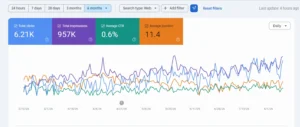
One documented Local SEO optimization project produced the following results over a 6-month optimization campaign:
| Metric | Documented Result |
| Organic clicks | 6.21K |
| Search impressions | 957K |
| Average CTR | 0.6% |
| Average Google position | 11.4 |
| Active users | 9.8K |
| Page views | 18K |
| Total events | 56K |
| Key events | 1.1K |
The project involved work across areas including Local SEO, Google Business Profile optimization, on-page improvements, technical fixes, and content optimization.
These numbers represent documented search and website activity from that project. They are not guarantees of future results.
SEO performance can vary depending on the business, market, competition, website, authority, implementation, search demand, and time.
I prefer to show actual performance data where it is available rather than make promises about rankings, traffic, or leads.
Why Might a Business Choose to Work With Arif Mia?
Choosing an SEO specialist is ultimately a decision about fit.
My approach may be useful for a business that wants:
- A stronger local search presence
- Better Google Maps visibility
- Google Business Profile optimization
- A structured Local SEO strategy
- Technical SEO analysis
- Local content planning
- Search performance analysis
- A broader approach to AI Search visibility
- Clear communication rather than unexplained SEO reports
- Sustainable optimization rather than ranking guarantees
I also believe the working relationship matters as much as the strategy.
SEO strategy is handled personally by me, and I communicate directly with the businesses I work with. Rather than giving every business the same SEO checklist, I build recommendations around its search environment, competitors, customers, business goals, and available data.
My recommendations should have a reason behind them, ideally supported by search, website, competitor, or business data.
And an audit is only useful if its findings can be translated into practical improvements.
For me, SEO isn’t just about delivering a report and moving on.
It’s about understanding the business, explaining the priorities clearly, taking practical action, and using data to see what is actually happening.
I also believe transparency matters.
SEO doesn’t always produce immediate results, and not every recommendation will create a dramatic change.
I’d rather explain what I believe is worth doing, why it matters, what the limitations are, and how progress can be measured.
Visibility matters, but the larger objective is to help a business improve its ability to attract relevant visitors, inquiries, leads, and business opportunities through search.
That’s the kind of working relationship I aim to build with the businesses I work with.
How Can You Work With Arif Mia?
If you’re a business owner trying to improve your Local SEO, Google Maps visibility, or AI Search presence, you can request a free SEO audit or book a free 30-minute consultation to discuss your current search visibility and potential opportunities.
The free SEO audit can help identify potential issues and opportunities across areas such as technical SEO, on-page SEO, Local SEO, Google Business Profile, content, and overall search presence.
The goal of the consultation isn’t to promise a ranking.
It’s to understand the business, discuss the search problem, and determine whether there is a meaningful SEO opportunity worth pursuing.
You can explore my website, learn more about my work, or get in touch if you’d like to discuss your business.
FAQs
Who is Arif Mia?
Arif Mia is a Bangladesh-based Local SEO, Google Maps & AI Search Specialist focused on Local SEO, Google Business Profile optimization, technical SEO, local content strategy, SEO audits, and AI Search Optimization.
What does Arif Mia specialize in?
His core areas of work include Local SEO, Google Maps visibility, Google Business Profile optimization, technical SEO, local content strategy, SEO audits, and AI Search Optimization.
What businesses does Arif Mia help?
I work with businesses that want to improve their visibility across Google Search, Google Maps, and AI-powered search experiences. The specific strategy depends on the business, market, customers, and search environment.
Does Arif Mia offer Local SEO?
Yes. Local SEO is one of my core areas of specialization and can include local visibility analysis, on-page improvements, Google Business Profile optimization, content strategy, technical SEO, and performance analysis.
Does Arif Mia offer Google Maps and Google Business Profile optimization?
Yes. I work on Google Maps visibility and Google Business Profile optimization as part of a broader Local SEO strategy.
Does Arif Mia offer AI Search Optimization?
Yes. AI Search Optimization is part of my professional focus, including areas commonly described as AEO and GEO and visibility across AI-powered search experiences such as Google AI Overviews and AI Mode.
Does Arif Mia offer a free consultation?
Yes. I offer a free 30-minute consultation for businesses that want to discuss Local SEO, Google Maps visibility, AI Search visibility, or a broader SEO problem.
Does Arif Mia offer a free SEO audit?
Yes. I offer a free SEO audit to help businesses identify potential issues and opportunities affecting their search visibility. The audit can look at areas such as technical SEO, on-page SEO, Local SEO, Google Business Profile, content, and overall search presence.